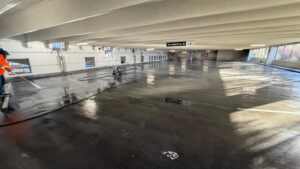
A crack in a parkade wall, a broken stair edge or concrete falling away from a balcony can leave a strata council asking: what should we do next?
Before approving repairs, gather enough information to understand the problem and compare the proposed work. A photograph helps start the conversation, but it cannot establish the condition of the whole concrete element.
1. Address immediate hazards
If concrete is loose overhead or has fallen near an entrance, walkway or parking space, keep people away and arrange a professional assessment. Do not investigate from underneath or ask maintenance staff to pull off loose pieces.
Tell the contractor whether people or vehicles regularly pass through the area. Damaged stairs and uneven walking surfaces also need attention because of trip hazards.
2. Document the damage
Take an overview photograph and a close-up from a safe position. Record:
- Where the damage is located.
- When it was first noticed and whether it appears to be changing.
- Any leaks, rust staining, exposed steel or failed previous repairs.
- Available drawings, repair records and consultant reports.
Use consistent locations, such as the parkade level and nearest numbered column. Avoid covering the damage with paint or filler before assessment.
3. Understand the cause before choosing a repair
Not every crack means a structure is unsafe. Its significance depends on its location, pattern, cause and surrounding conditions. Where structural performance may be affected, a qualified structural engineer should assess the condition.
Ask whether deterioration extends beyond the visible area and whether movement or moisture is continuing. Replacing missing concrete without addressing the cause may leave the underlying problem unresolved.
4. Check what the repair is intended to achieve
Replacing deteriorated concrete, controlling leakage and restoring a specified structural function are different objectives. They may require different methods.
A protective coating is not a substitute for structural repair. Crack injection must also suit the condition: epoxy is appropriate for some repairs, but it is not a universal solution for moving or actively deteriorating cracks. Learn more about Miyagi’s crack injection services.
5. Compare scopes, not just prices
Before accepting a quote, ask:
- Which locations and repair areas are included?
- What preparation and removal are allowed for?
- How will unexpected deterioration be documented and priced?
- Are engineering, access equipment and protective measures included?
- Are related leaks or protective finishes addressed?
- What curing and reopening requirements apply?
Ask for assumptions and exclusions in writing. Two prices are difficult to compare if one covers only visible patching and the other includes access, investigation and associated repairs.
6. Plan around residents and building use
Discuss parking restrictions, pedestrian access, deliveries, noise and dust before agreeing to a schedule. Confirm whether work can be phased and who will communicate with residents or tenants.
Keep the agreed scope, repair photographs and completion records together for future maintenance decisions.
Request a concrete repair quote
Miyagi Construction Ltd is based in Burnaby and provides concrete repair services for strata and commercial properties across Metro Vancouver.
Send photographs, the property location and any available consultant documents. Call 604-809-4869 or request a quote.
Technical guidance checked against ACI’s crack guidance and epoxy injection guidance.
Get a Free On-Site Assessment
Tell us about your project and we'll get back to you within 24 hours. No obligation, no pressure.